Introduction
A land parcel may look suitable for a house or plotted layout while its official classification still shows agricultural wetland. A proposed sale, layout drawing or broker assurance does not change that classification.
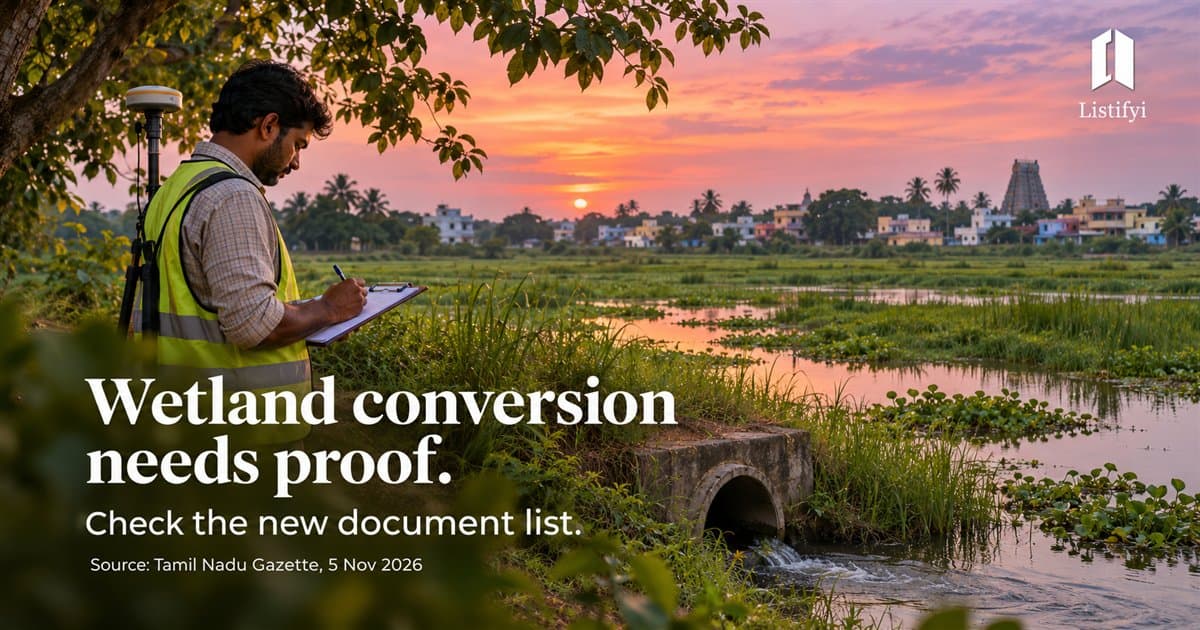
Tamil Nadu published amendments to its rules on changing land use from agriculture to non-agricultural purposes in non-planning areas in a Gazette dated 5 November 2026. The amendment specifies documents for applications involving wetlands and updates how the application moves through the online system.
Quick Answer
What changed for a Tamil Nadu wetland conversion application? The amended rules require specified land, drainage and site documents to be uploaded through the online Single Window Portal. For wetland cases, the Director must obtain no-objection certificates from the relevant Revenue Divisional Officer, Joint Director of Agriculture and Water Resources Department Executive Engineer. An application is not permission to build.
What You’ll Learn
Which documents the amendment lists
Why drainage and nearby development are part of the review
What a buyer should verify before purchasing land
The document list in the Gazette
For a wetland development application under these rules, the Gazette lists a self-attested sale deed, lease deed or power of attorney; patta; site drainage plan; site plan at an appropriate scale; and a proposed layout, subdivision or building plan where applicable.
It also calls for a topographical plan showing existing development within a 500-metre radius as depicted in the village map; an online affidavit that land belonging to others or the government is not included; a self-attested Chitta; and Adangal records for the recent three fasli years including the current year.
The amendment replaces the phrase “online portal” with “online Single Window Portal.” It also specifies the three departments from which the Director is to obtain no-objection certificates for wetlands. Read the Gazette itself for the exact wording and scales.
What a buyer should ask the seller
Ask for the current land classification and survey details in official records. Check whether the parcel falls within a non-planning area covered by these particular rules. Request the land-use conversion order if the seller claims conversion has already happened. An acknowledgement showing that documents were uploaded is not the final order.
Compare the patta, Chitta, Adangal and deed for survey number, extent and owner details. A mismatch deserves clarification before a deposit. Walk the land after rain if possible and study how water enters and leaves the site. The required drainage plan and topographical map are useful because they force this question into the approval record.
What the amendment does not mean
It does not say that every wetland is convertible, that environmental restrictions disappear, or that building permission follows automatically. Other laws, local planning controls and site-specific restrictions may apply. A buyer should obtain the final written orders relevant to the exact survey number and proposed use.
Frequently Asked Questions (FAQ)
Can I build once the application is submitted?
Why are Chitta and Adangal required?
Does the amendment cover all Tamil Nadu land?
Sources and Limitations
Source: Tamil Nadu Government Gazette No. 477, published 5 November 2026. This article summarises the amendment, not the approval status of any particular parcel. Images are illustrations.
Next Steps
Collect the official survey and land records, check the applicable planning area, and ask for the final conversion and building orders before buying land for development.