Reddit Says Bengaluru Property Gives 2% Rental Yield vs 7% on FD. Here's What the Real Math Actually Shows in 2026
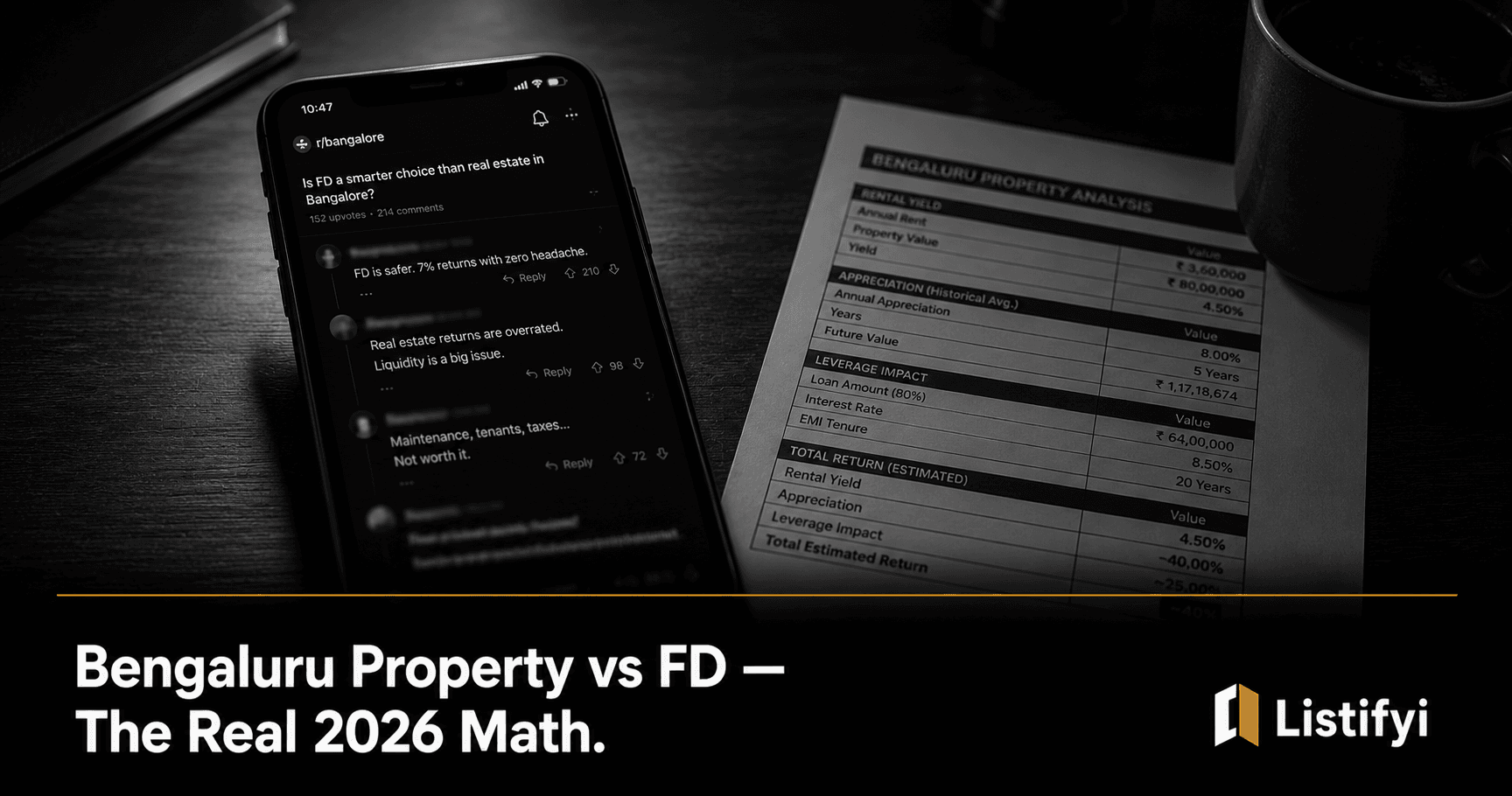
Open r/bangalore, Team Blind, or FinTwitter this month and the same argument is on repeat: "Bangalore property gives you 2% rental yield. FD gives you 7%. Buying a house is stupid."
One viral Blind post captured it perfectly. A tech professional, ₹2.5 crore net worth, about to book a ₹1.7 crore resale 3 BHK, ends the post with buyer's remorse: "Feeling that renting (₹40-55k) would have been cheaper than depleting my entire portfolio + home loan." The top comment: "Current stock market returns are 25%+, FD is giving 8%. If you put ₹2.5 cr in just FD, returns are more than your rent cost. Why to buy?"
Hundreds of upvotes. Thousands of shares. Genuinely convincing on the surface.
Except the math is wrong. Not "opinion" wrong — arithmetically wrong. Here's what the numbers actually show when you stop cherry-picking them.
Correction #1: Bengaluru rental yield isn't 2%. It's 3-4.5%.
The Anarock national residential report puts Bengaluru's rental yield at 4.45% — the highest of any major Indian city, well above Mumbai (4.15%), Gurugram (4.1%), Delhi (2.9%), and Hyderabad (3.2%). The "2% yield" number floating around Reddit comes from cherry-picking premium ₹3-5 crore Indiranagar villas rented at ₹80k, where the yield genuinely drops that low.
For the actual middle-class case — a ₹1 crore flat renting at ₹30-35k/month — the yield is ~3.6-4.2%. For a ₹1.7 crore 3 BHK renting at ₹55k, it's ~3.9%. Not 2%. That's the first number the viral take gets wrong.
Correction #2: Rental yield alone was never the point. Total return is.
FD returns are just interest. Property returns are yield plus appreciation. You can't compare the two by looking at yield only — that's like comparing a stock's dividend to an FD and ignoring the share price.
Bengaluru property prices grew 6-12% city-wide in 2026, with 8-10% being the mid-band norm across established corridors. Rents themselves rose 8-15% YoY in 2026, the highest rental inflation of any major Indian city.
So the real total return math on a ₹1 crore flat is:
Rental yield: ~3.6% (net of society maintenance, property tax, one-month vacancy allowance)
Capital appreciation: ~8% (Bengaluru city-wide average)
Gross total return: ~11.6% pre-tax
FD at 7.25% pre-tax, for someone in the 30% tax bracket, delivers ~5.1% post-tax. Property capital gains are also taxed, but with indexation on long-term holdings and Section 54 exemptions if reinvested, effective post-tax property returns for most middle-class buyers still land in the 9-10% range.
That's not "worse than FD." That's meaningfully better than FD — before we've even added leverage.
Correction #3: The FD comparison ignores leverage, which is the biggest advantage buying actually has.
The Reddit hot take assumes you park ₹2.5 crore in FD as an alternative to buying. Nobody buys a ₹1.7 crore flat that way. They put ₹34 lakh down (20%) and borrow ₹1.36 crore at ~8.4% home loan rate.
That leverage is the mathematical secret sauce nobody quotes on Reddit:
You control a ₹1.7 crore asset with ₹34 lakh of your own money
If the flat appreciates 8%, that's ₹13.6 lakh gain on ₹34 lakh cash deployed = ~40% return on your own capital in year one
Loan interest is tax-deductible (up to ₹2 lakh under Section 24, plus principal under 80C)
Meanwhile the "₹2.5 crore in FD" scenario is deploying all ₹2.5 crore of capital to earn 7% pre-tax
Leverage cuts both ways — if property values fall, losses amplify too. But over 7+ year Bengaluru holding periods, historical data shows appreciation, not depreciation, in genuinely well-located inventory.
Correction #4: You have to live somewhere. That's not a comparison, it's a constant.
The FD-vs-property debate on Reddit is really two different debates smushed into one:
Should I buy a house to invest in? (a comparison against equity, FDs, mutual funds)
Should I buy a house to live in? (a comparison against renting)
For a home you'll live in, the "opportunity cost" isn't 7% FD — because in the rent scenario, you're paying ~₹40-55k/month in rent that you would otherwise not pay if you owned. That rent-saved is real, tax-free, inflation-linked income equivalent. Add it to the yield math and the buy case gets stronger, not weaker.
Which is exactly why the smart Bengaluru move most people miss is a third option: rent where you work, buy where the growth is. Live on rent in an established corridor near your office, own an appreciating asset in a developing corridor, rent it out to partially cover the EMI. Rent for lifestyle. Buy for wealth. Both, not either.
Where the FD side of the debate is actually right
Property does lose the math race in these scenarios, and Reddit isn't wrong to flag them:
Short holding periods. Buy-and-sell within 3-4 years and stamp duty + registration + brokerage + interiors eat 12-15% of your price — appreciation can't recover that. If you might move cities in 3 years, FD really does win.
Over-leveraged EMI. If EMI exceeds 45% of take-home, you're one job loss from panic. FD money can be withdrawn; a distressed property sale sees you eating 15-20% off market rate. Prudence beats leverage here.
Buying badly. A ₹1 crore flat in a poorly-connected pocket appreciating 3% while comparable Sarjapur inventory appreciates 10% — you lost the game at the purchase decision, not the maths. This is where most Reddit horror stories actually come from.
Not comparing to equity. Nifty 50's long-term CAGR sits around 12-13%. Disciplined equity investors sometimes do beat property total returns — the operative word being disciplined, which most people saying "I'd have put it in equity" actually aren't.
The hidden ingredient the viral debate never mentions
Every honest property calculation depends on one thing you can't get from a spreadsheet: did you buy at fair value or did you overpay?
Overpay by 15% at booking and you've silently wiped out two years of appreciation on day one. The Bengaluru primary market is saturated with premium new launches, glossy renders, and "starting from ₹" pricing that hides floor and view premiums. The resale market has decade-old listings still photographed with wide-angle tricks that make cramped balconies look luxurious.
This is why the whole debate assumes something that isn't automatically true: that you can accurately judge what a property is worth before you buy it. In a photo-only listing world, you can't. In a video-verified listing world — where you see the real light, the actual society condition, the honest walk from unit to metro alignment — you can. And the FD-vs-property math only works when the "property" side of that equation reflects reality, not marketing.
Where Listifyi fits into this debate
Listifyi is built for the buyer who wants the property math to actually work. Every listing — primary new launch, resale, and rental — carries a real walkthrough video, so you're not paying luxury prices for a mid-tier property or overpaying resale because the photos hid what the video would have shown. You can genuinely compare a ₹1.4 crore new launch against an ₹85 lakh resale in the same society and decide with honest information. That's the difference between buying at fair value and paying the "I didn't know" tax.
Frequently asked questions
Is Bengaluru's rental yield really only 2%?
No. According to Anarock's national report, Bengaluru's residential rental yield is ~4.45% — the highest among major Indian cities. The 2% figure comes from cherry-picked premium villa examples that don't reflect typical mid-segment yields of 3.5-4.2%.
Is it better to invest ₹2 crore in FD than buy a Bengaluru flat?
For a pure investment, it depends on horizon and tax bracket. Property total returns (yield + appreciation) in Bengaluru currently run 10-12% pre-tax; FD returns 7% pre-tax (~5% post-tax at 30% slab). Property wins on total return but only if held 7+ years and bought at fair value. For a home to live in, the FD comparison misses the rent-saved benefit and usually favours buying.
Does leverage change the property vs FD math?
Significantly. A 20% down payment with 80% home loan means your ~8% capital appreciation translates to ~40% return on your own equity in year one (before EMI outflow). FD offers no leverage benefit. This is the biggest math advantage buyers have.
What holding period does buying start winning at?
Historically in Bengaluru, 7+ years. Below 5 years, transaction costs (stamp duty, brokerage, interiors, exit brokerage) eat too much of the appreciation for property to comfortably beat FD or equity.
What's the biggest reason property buyers lose the math race?
Overpaying at purchase. A 15% overpay on day one silently erases 2 years of appreciation. This is where photo-only listings fail buyers most — the price you paid was fair for the property in the photos, but not for the property you actually got.
Final word
The Reddit "2% yield vs 7% FD" hot take is a great tweet. It's a bad calculator. Real Bengaluru rental yield is 3-4.5%. Add 8% appreciation. Layer on leverage. Subtract the rent you'd otherwise pay. Adjust for tax bracket. Now compare it to FD.
For a home to live in over 7+ years, bought at fair value in a growing corridor, the math still favours buying — comfortably. For a short-horizon, over-leveraged, over-priced buy in a pocket that's not growing, FD wins easily.
The variable that decides which one you are isn't in the tweet. It's in whether you can see the actual property before you pay for it.
👉 Explore video-verified homes across Bengaluru — new launches, resale, and soon rentals — on Listifyi.