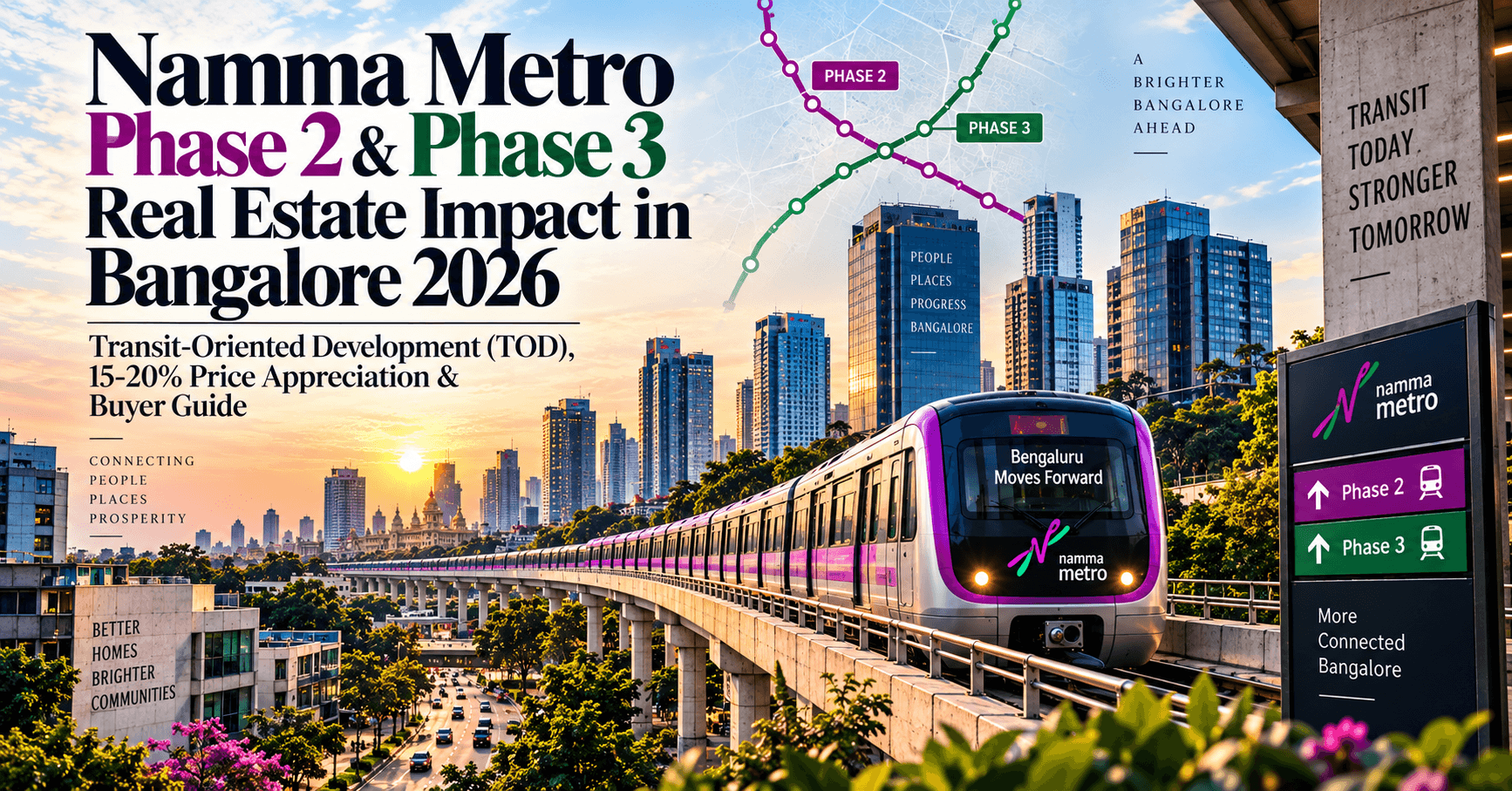
As Bangalore’s traffic congestion continues to challenge daily commuters, physical proximity to mass rapid transit has become the single most powerful driver of real estate value. In 2026, the operational maturity of the Purple and Green lines, combined with ongoing construction and route expansions across Namma Metro Phase 2 and Phase 3 networks, has fundamentally reshaped residential and commercial capital appreciation. Properties situated within a 0 to 2-kilometer radius of active metro stations command massive rental and resale premiums, outperforming non-transit micro-markets by significant margins.
Navigating transit-driven real estate requires understanding Transit-Oriented Development (TOD) zoning policies, micro-market appreciation trends, and smart property buying strategies. This comprehensive guide breaks down Bangalore’s metro corridor dynamics, premium FSI incentives, price appreciation benchmarks, and smart acquisition strategies for 2026.
What You'll Learn:
The direct correlation between Namma Metro expansion (Phase 2 & Phase 3) and property price appreciation (15% to 20% premiums)
How Transit-Oriented Development (TOD) policies enable higher Floor Area Ratios (FAR) and mixed-use density near transit hubs
High-potential transit corridors across Outer Ring Road, Whitefield, Electronic City, and West Bangalore
Critical due diligence checks when buying near metro tracks (vibration analysis, noise insulation, and zoning clearances)
How to discover verified transit-adjacent properties directly on Listifyi without broker spam