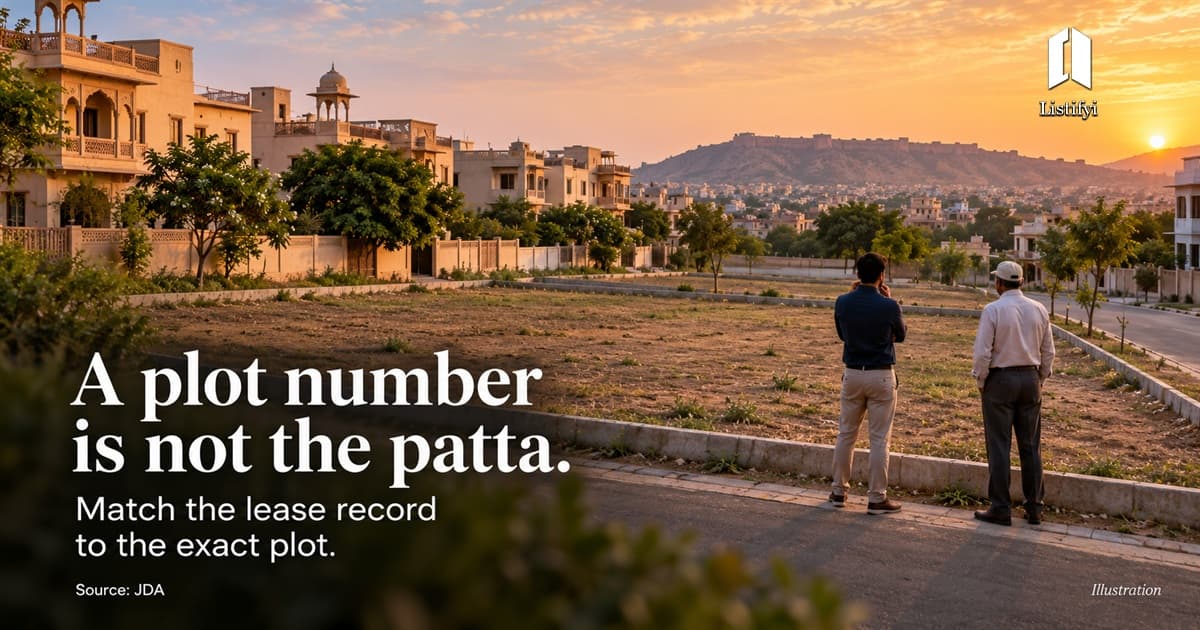
A plot number in an advertisement helps you find a property. It does not prove the seller’s title, the scheme’s approval or the exact boundaries on the ground. When a Jaipur plot is marketed using the JDA name, begin by checking which authority and documents actually govern that plot.
Quick answer
Ask the seller for the allotment history, patta or lease deed where applicable, transfer documents, approved layout and current dues position. Match the plot number, area and boundaries in those records to a physical site visit. Use the official Jaipur Development Authority portal to identify available verification services and the relevant office. Do not pay a token amount solely on the strength of “JDA-approved” in an advertisement.
What you will learn
Why the scheme and issuing authority come first
Which plot details must agree across records
What to resolve before paying a seller
Establish what the seller is selling
First ask: Is this a JDA allotment, a plot in a private township, or land governed by another urban local body? The answer determines which records and permissions you should request. Not every Jaipur plot has the same kind of patta, and an allotment letter is not automatically the final title document.
For a plot presented as a JDA plot, request the allotment letter and subsequent transfer chain, the applicable patta or lease deed, and the seller’s identity documents. Have a local property lawyer confirm the tenure, the seller’s ability to transfer and whether further approvals or dues are involved.
Match the paper plot to the physical plot
Compare the scheme name, plot number, measured area, road access and boundaries across the seller’s documents, authority records and site. If a plan shows a road, visit the site to see its actual position and access. If the area differs, have it resolved before price and payment are final.
An attractive location pin is not a boundary survey. For a costly purchase, a qualified survey and independent document search can be worthwhile.
Claim | Check |
|---|---|
“JDA-approved” | Which authority approved what, and for which scheme? |
“Patta is available” | Whose name is on it, and does it match this plot? |
“No dues” | Current written dues or clearance position |
“Road-facing” | Approved layout and physical access |
Check development and transfer conditions
The Rajasthan Township Policy available through JDA describes documentation and development processes that can differ by scheme. Ask whether the document shown is provisional or final and whether the road, services and transfer requirements stated for that scheme have been met. Do not assume a future regularisation will fix missing paperwork.
Frequently Asked Questions (FAQ)
Is a plot number enough to confirm ownership?
Does every Jaipur plot need a JDA patta?
Can I rely on “JDA-approved” in a listing?
Should I pay a token before checking dues?
What if the plot area differs between the paper and site?
Sources and limitations
Jaipur Development Authority and the Rajasthan Township Policy hosted by JDA. Requirements vary by scheme and tenure; this article cannot verify a particular plot.
Next steps
Explore land listings on Listifyi properties. Agents and plot sellers can join Listifyi for Business and present the exact scheme, tenure and documents available for buyer review.