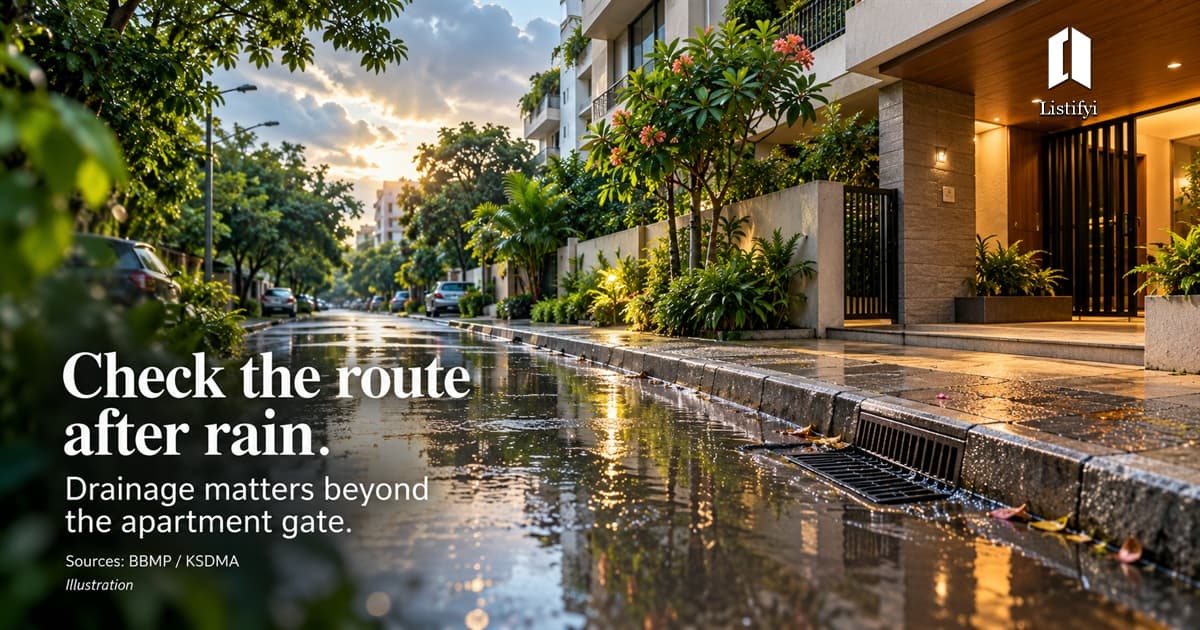
A flat may stay dry while the road to it becomes difficult to use after heavy rain. That difference matters to daily travel, deliveries and emergency access. When buying in Bengaluru, assess the route and surrounding drainage, not only the apartment interior.
Quick answer
As of 29 October 2026, revisit the property during or soon after substantial rain when it is safe to do so. Check the approach road, low points, drains, basement entry and alternative access. Ask residents about repeated waterlogging and compare their account with available civic and risk information. Karnataka’s flood risk management action plan identifies storm-water drainage and land-use planning as important flood measures; it does not certify an individual building as safe.
What you will learn
What to inspect beyond the gate
How to distinguish a wet road from a recurring access problem
Which evidence to keep before booking
Walk the full approach
Start from the main road or transit stop you would actually use. Note underpasses, low junctions, open drains and places where water has nowhere obvious to flow. At the building, look at the height of the entrance relative to the road and the route into basement parking. A beautiful lobby is less useful if its only access is routinely cut off.
Do not enter moving floodwater or an unsafe basement for the sake of a viewing. Ask the association or management for past incident records, basement pumping arrangements and what happened during the most recent heavy rainfall.
Place to check | What it can reveal |
|---|---|
Main approach junction | Whether traffic and access stop after rain |
Road outside the gate | Local pooling and drain condition |
Basement ramp | Potential route for water into parking |
Alternate road | Whether residents have another safe way in |
Use maps as a starting point
Civic maps and risk studies help you ask better questions, but their scale may not resolve a single plot. The Greater Bengaluru Authority site provides planning and map services, while BBMP’s climate action material contains city-level flood-risk mapping. Check the date, coverage and limits of any map before relying on it.
A dry-season site visit cannot demonstrate how a road behaves in rain. Equally, one puddle after a storm does not prove a building floods every year. Look for a pattern supported by visits, resident accounts and records.
Put the findings into your decision
If access is a concern, ask what drainage work has been completed, who maintains it and whether your lender or insurer needs further information. Compare the price with another property whose access works better for your routine. Do not accept an unverified promise that a proposed drain will solve the issue.
Frequently Asked Questions (FAQ)
If the flat is on a high floor, can I ignore flood risk?
Is one dry visit enough?
Does a flood map prove my exact flat will flood?
What should I ask residents?
Should I rely on promised future drainage work?
Sources and limitations
Karnataka flood risk management action plan, Greater Bengaluru Authority and BBMP climate action material. Conditions change by street and rainfall event; no map or illustration here identifies a particular property.
Next steps
Compare Bengaluru homes on Listifyi properties. Agents and property businesses can join Listifyi for Business and give buyers accurate access and drainage information.